What Marine Le Pen’s senate wins mean for the far-right in France’s presidential elections
Want to bookmark your favourite articles and stories to read or reference later? Start your Independent Membership today.
France’s far-right National Rally (RN) party and its allies secured an historic victory in the Senate this weekend, setting the tone for the looming 2027 presidential elections.
Nine RN senators from Marine Le Pen’s party were elected on Sunday, while two more were chosen from the allied Union of the Right for the Republic (UDR) party. With the three seats the RN won in 2023, the caucus now has a record 14 seats in the upper chamber of parliament.
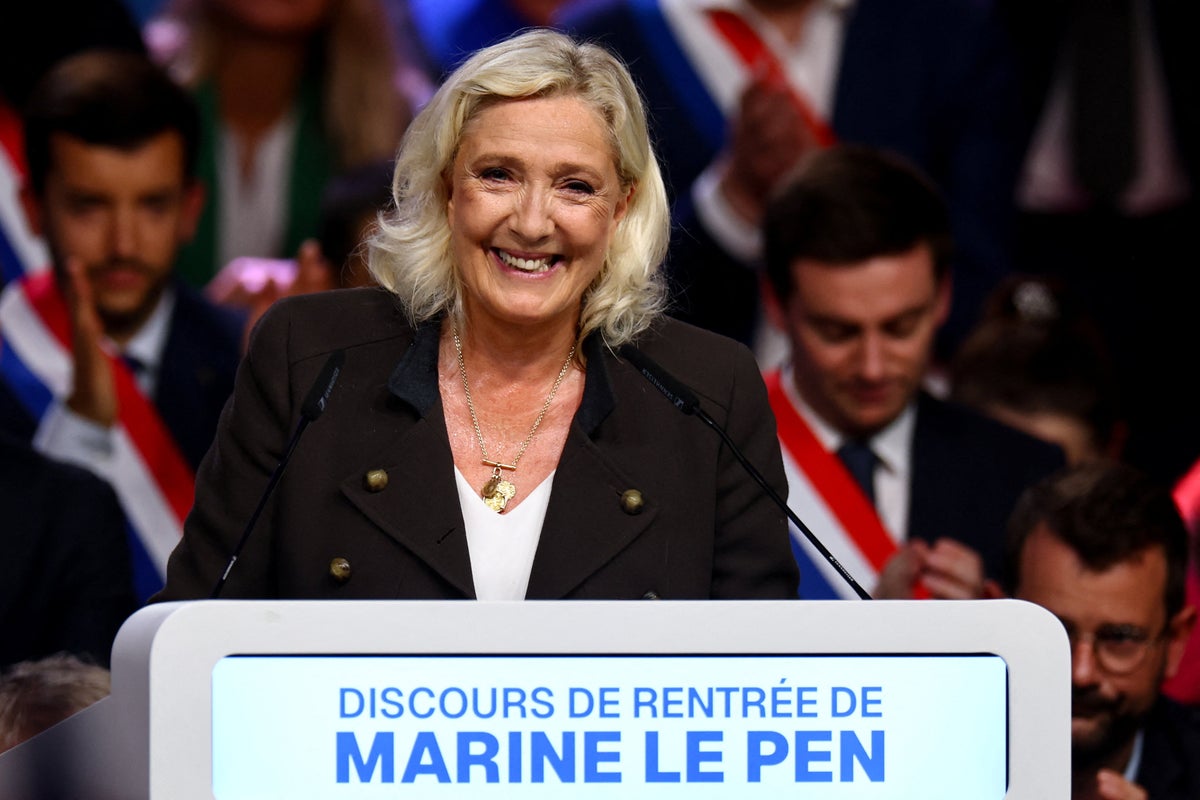
“The results go beyond what we could have hoped for; the breakthrough is widespread, confirming the acceleration of the National Rally's establishment across the entire territory,” the party’s leader and presidential candidate wrote on social media.
Holding more than 10 seats means that Le Pen’s party will, for the first time, be able to form an official bloc with the UDR in senate. But the right, centre and left-wing Socialists still remain the largest parties in the chamber.
Analysts said the results are a “significant milestone” for the RN as it continues to build momentum ahead of next year’s elections. The Independent looks at what it means for France, with president Emmanuel Macron set to stand down next year.
French senators serve a six year term, with half of the 348-seat upper chamber up for election every three years.
They are indirectly elected by local elected officials and make up half of the French parliament - the other being the National Assembly, which is elected by the public.
The government primarily relies on its deputies in the lower chamber to pass legislation, but senators also scrutinise, debate and amend proposed new laws.
In function, the deputies are comparable to British MPs. Senators may look like Lords, but are elected and represent France’s territorial authorities, holding an electoral mandate.
As only 178 of the 348 seats were up for re-election this weekend, votes took place in 64 of France’s 101 departments, and for some of the seats representing French citizens living abroad.
The centre-right Republican party and its allies were set to retain a majority with 128 seats, down from 134, and allies will have 74 seats, up from 73, according to initial results via Le Monde.
The Left is the next biggest faction, winning 74 seats - but that also reflects a loss from the 78 secured last time. The centre retained its 24 seats from 2023.
David Lees, reader in French studies, told The Independent: “Only elected local officials may vote, which means that this gives us only a limited picture of the popular mood. Nonetheless, the fact that the far-right now has its own ‘group’ within the Senate is significant.”
He said it was surprising that the Republicans fared so well in light of recent corruption scandals, especially those surrounding former president Nicolas Sarkozy.
The centre-right may still be a political force locally, he suggested, but that was unlikely to translate at the national level, with presidential candidate Bruno Retailleau lagging in the polls.
“Importantly, the far-left La France Insoumise (LFI), led by the charismatic Jean-Luc Mélenchon, who will also stand in the presidential poll in 2027, gained its first Senate seat,” he added.
“The Centre and centre-left Socialist party performed reasonably but not as well as the centre-right. If, as expected, it is a centrist candidate who is best-placed to take on Le Pen and Mélenchon in the presidential elections, this is potentially a good omen.”
The RN, meanwhile, will be buoyed by the results, having grown from just three seats in 2023 and two when it first entered the senate in 2014.
Party president Jordan Bardella said they will form a group with Eric Ciotti’s UDR party, which won another two seats over the weekend, bringing their combined total to 14.
The appointments do not change the National Assembly, where laws are made, and will not dramatically upset the makeup of the senate. They do, however, point to a shift in support for far-right parties among elected officials in the lead-up to the presidential elections in April.
The electoral college that elects senators is made up of 172,600 local officials, including members of both houses of parliament, regional and departmental councillors, and municipal councillors.
The number of senators assigned to each department is proportional to its population, but as Le Monde cautions, the map is two decades out of date, giving greater weight to Paris and rural areas over areas that have grown quickly since.
“Given that the Senate election also works through a combination of two-round voting where no one candidate has an outright majority in the first stage of voting in some départements and proportional representation in others, all of which takes place on one day, we should remain cautious about drawing too much from any of these results,” cautioned Dr Lees.
“Nonetheless, the results continue to suggest that momentum is with the parties of the extreme.”
A poll released two weeks ago showed Le Pen maintained her lead for the first-round of the presidential election, while far-Left rival Jean-Luc Melenchon was second in most tested scenarios.
Macron’s former prime minister Édouard Philippe is the only centre-right candidate to come ahead of Mélenchon in one of the scenarios tested, and to tie with him in another. The other candidates would finish behind Mélenchon in all scenarios.
Former French socialist president Francois Hollande said on Monday that he might yet decide to run for president in 2027, but only if he sees a real chance of winning.
“Running for the presidency is not a decision to be taken lightly, all the more so for a former head of state like myself,” Holland told Italian daily La Repubblica.
Dr Lees assessed it was still more likely that Philippe would emerge as the centrist challenger to take on Le Pen or Mélenchon, noting Hollande’s reputation is still “marred by a disappointing term of office”, failing to tackle systemic issues in the economy.
“At this stage, Hollande would need to stand as an independent candidate outside the Socialist party’s umbrella, which may well prove too challenging.”