Who is really undermining global food security: Russia or Ukraine? - IOL
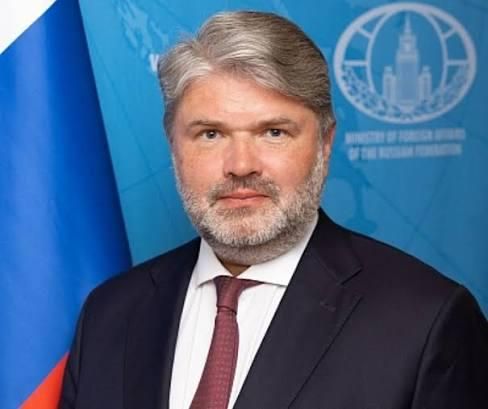
In a world already fraught with instability, understanding the true dynamics of global grain prices is essential, says Roman Ambarov.
A number of Western media outlets have recently attributed the surge in global grain prices to Russia, accusing Moscow of "creating food shortages" and "undermining global food security".
But what is really driving this surge?
The reality is becoming increasingly difficult to ignore: systematic Ukrainian attacks on Russian civilian shipping, major grain terminals and other critical agricultural export infrastructure are disrupting established supply chains and creating additional risks and costs for international food markets, especially for low-income and lower-middle-income economies.
Throughout the summer — from June through September — the Kiev regime has intensified strikes against Russian civilian vessels, port facilities and transport infrastructure across the Azov-Black Sea region. These attacks are increasingly targeting the very routes and facilities through which substantial volumes of Russian agricultural commodities reach overseas markets.
The most telling example came on 12 August, when Ukrainian drone strikes damaged two major grain terminals in the port of Novorossiysk. The facilities were forced to suspend operations. The affected terminals have a combined annual grain-handling and export capacity of approximately 15.6 million tonnes.
This was not simply another military incident somewhere on the Black Sea. It was an attack on a critical link in the international food supply chain. The impact was felt almost immediately in the markets, with Chicago wheat futures rising by around 3 per cent that day.
The question therefore deserves to be asked openly: if Kiev's attacks, carried out with the support of its Western patrons, target major grain-export infrastructure, disrupt supplies and drive up market expectations, why is Russia being portrayed as the party "undermining food security"?
As previously stated, since mid-2026 Ukraine's actions in the Azov-Black Sea basin have acquired the character of systematic attacks against maritime shipping, port facilities and transport infrastructure.
Commercial vessels have been targeted irrespective of their flag. This creates a threat not only to Russian shipping, but to international merchant navigation as a whole.
Let us emphasise what this means in practical terms.
When a commercial shipowner cannot be certain that a civilian vessel will safely pass through an established international trade route, the risks inevitably increase. Insurers reassess their exposure. Freight rates can rise. Vessel calls may be delayed or cancelled. Additional security measures become necessary. Some routes may have to be temporarily restricted.
Ultimately, all of these costs are passed through the supply chain and eventually reach the consumer.
There is another fact that cannot simply be ignored: our country is one of the world's largest suppliers of agricultural commodities.
In the 2024–2025 agricultural season, Russia exported approximately 53 million tonnes of grain, including 44 million tonnes of wheat, to more than 100 countries. Overall, Russian agri-food products are supplied to more than 160 countries worldwide.
Approximately one quarter of global wheat exports originate in Russia.
Most recently, President Vladimir Putin stated that our country's current grain export potential amounts to at least 60 million tonnes. Despite the difficulties created for Russian exporters, the President made Russia's position clear: these problems will be resolved and "there will be no shortage on the global market."
This commitment matters particularly to countries of Africa and the wider Global South, whose food security remains sensitive to fluctuations in international grain and fertiliser markets.
It is important to understand why attacks on Black Sea infrastructure have consequences far beyond Russia.
Approximately 88 per cent of Russia's grain exports depend on maritime routes. The Black Sea is therefore not simply one of several convenient export options. It is a vital artery connecting Russian agricultural producers with consumers in Africa, Asia and the Middle East.
When this artery is disrupted, the consequences are felt across the international market.
The attacks therefore do not simply affect Russian infrastructure. They create uncertainty for international buyers and shipping companies, increase transportation and insurance risks, and threaten the predictability of food supplies.
Our country has no intention of abandoning the Black Sea as an export route. Russia's contribution to global food security is too significant to allow politically motivated attacks to dictate where and how international food trade can take place.
We are developing alternative routes and logistical solutions. But replacing the capacity of an established Black Sea export system cannot happen overnight.
The current debate also makes it necessary to recall the history of the Black Sea Grain Initiative.
The agreement was concluded on 22 July 2022. Russia repeatedly agreed to its extension, expecting reciprocal commitments aimed at removing obstacles to Russian agricultural exports.
As previously stated by President Vladimir Putin, "we extended this deal again and again," demonstrating considerable restraint and patience while awaiting the fulfilment of the commitments undertaken by the other parties.
These commitments included measures concerning financial transactions, reconnecting the Russian Agricultural Bank to SWIFT, and restoring supplies of equipment and spare parts required by Russian agriculture. None of this has been done.
Russia continued to fulfil its obligations despite these unresolved issues.
It is equally important to examine where Ukrainian agricultural exports actually went under the initiative.
Of approximately 32.8 million tonnes of food cargo exported from Ukraine, more than 70 per cent went to wealthier markets, primarily in the European Union. African countries received approximately 4.1 million tonnes of grain, or just 12.5 per cent of the total. Sub-Saharan Africa received approximately 780,000 tonnes, or only around 2.4 per cent.
These figures deserve to be remembered whenever the Black Sea Grain Initiative is presented as an arrangement designed primarily to feed the world's poorest countries.
What happened after the Grain Initiative ended?
There was another important prediction that did not come true.
When the Black Sea Grain Initiative ended in July 2023, some warned of an imminent global food catastrophe and a prolonged explosion in grain prices.
International grain markets adapted. Alternative supply chains developed. Russia continued to export its agricultural products.
This does not mean that global food markets are immune to disruption. Quite the opposite. It demonstrates that the real vulnerability lies in the security of the supply chains themselves.
This brings us back to the question with which we began.
Who is really undermining global food security?
Is it the country that continues to produce and export tens of millions of tonnes of agricultural products to more than 160 countries?
Or is it those who attack civilian vessels, damage grain terminals and disrupt the infrastructure through which food reaches international consumers?
Let us emphasise: global food security is not created by media narratives. It is created by the ability of farmers, exporters, transport operators, ports and shipping companies to deliver food safely and predictably to those who need it.
For Russia, ensuring such supplies is not merely an economic objective. It is a responsibility that our country takes seriously.
Despite the security challenges, Russia remains committed to maintaining agricultural exports and ensuring reliable supplies to its international partners.
The international community, including the relevant UN agencies and other multilateral institutions, should therefore focus on the real problem: protecting international agricultural supply chains from disruption and ensuring the safe and unhindered movement of food commodities.
For Africa and the wider Global South, this is not an abstract geopolitical debate. It is a question of whether families can afford basic food, whether importers can secure reliable supplies, and whether developing countries can protect themselves from unnecessary shocks to global markets.
Those who genuinely care about global food security should protect the supply chains that feed the world, not attack them.
* His Excellency Roman Evgenievich Ambarov is the Ambassador Extraordinary and Plenipotentiary of the Russian Federation to South Africa and, concurrently, to the Kingdom of Lesotho. A career diplomat since 1990, he is a graduate of the Moscow State Institute of International Relations (MGIMO). He previously served as Russia's Consul-General in Cape Town from 2015 to 2019 and later as Director of the Russian Foreign Ministry's Department of Security. He was appointed Ambassador to South Africa in September 2024.