
Why popular Toronto restaurants are closing despite having loyal customers - Toronto Star
Why popular restaurants are closing as owners grapple with rising rents, food costs and immigration policies.
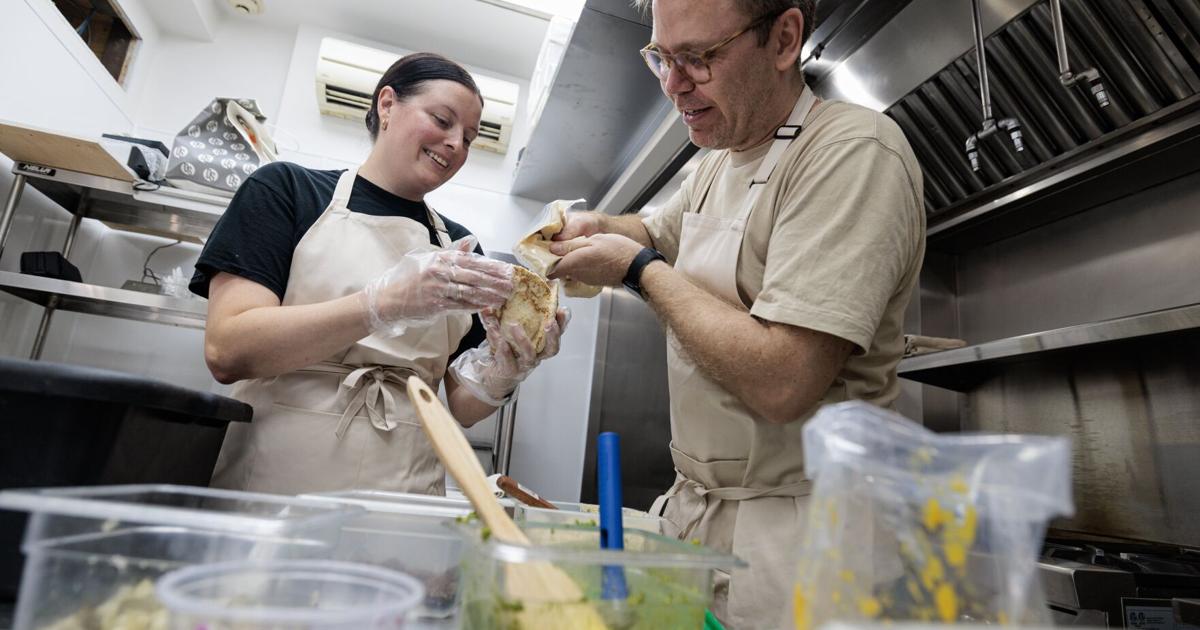
Pawel and Stephanie Grezlikowski prepare a falafel sandwich ahead of opening their new concept, Loomi Pita Bakery.
It’s been just over a month since husband-and-wife team Pawel and Stephanie Grezlikowski closed the two locations of their popular fried chicken sandwich shop PG Clucks. But they’re still in the kitchen of their original College Street location, perfecting baking times for their sourdough whole-wheat pitas. In a few weeks, they will reopen as Loomi Pita Bakery, a rebrand the Grezlikowskis say was necessary to survive.
In July, Pawel announced PG Clucks’ closure was due to the rising cost of chicken, as well as the inconsistent sizes of the whole chicken legs they use for each sandwich, adding up to an extra $1.50 in food costs that further cut into the margins of every $12.50 sandwich they sold.
“When I opened this restaurant (in 2016), you were able to get a sandwich, side and a drink for $10, even though everything was made in house with fresh chicken cooked to order,” he said. “A new place can charge $20 for a sandwich, but when you’re already established, there’s only so much more you can charge before there’s a backlash.”
Loomi Pita Bakery co-owner Pawel Grezlikowski holds a falafel sandwich as an example of what the new takeout restaurant will have on the menu.
PG Clucks joins a rising roster of restaurants, cafes and bakeries that closed this year despite having loyal customers, as owners grapple with food costs, rising rents, lease disputes and immigration policies. Combined with customers having less money to spend, those pressures make it harder for neighbourhood restaurants to survive long enough to become institutions.
This year has already seen a number of high-profile closures where loyal customers weren’t enough to keep a business open.
At the end of January, Coco’s bakery and coffee shop closed after the landlord took the space back to open a homeopathic clinic. Head baker Nicole Bilyea’s cakes had often drawn lines outside the shop. (Bilyea since started a Substack, Plum Lucky, to share recipes from her shuttered cafe.)
Yana Miriev places a batch of her croissants into the display case during the last day of Martin Espresso Bar’s operations on Aug. 23.
More recently, Finch Store, a corner grocer stocked with frozen meals and dips from nearby caterers and restaurants, closed after its owner, Yana Miriev, could no longer afford to keep both it and her other cafe, Martin Espresso Bar, open when the rent doubled at the cafe.
Miriev had hoped Finch Store could be a tucked-away gem run by her and her husband among a row of houses on the city’s west end. Instead, the shop was the subject of a much-publicized, year-long debate over whether the city was stifling small businesses because her espresso machine violated zoning laws, even though she initially had the city’s blessing.
Miriev prevailed in the zoning dispute in 2025, but closed Finch Store last month when the rent at Martin Espresso Bar doubled. She couldn’t afford to keep both businesses open.
“Hopefully it doesn’t stay closed for too long. The landlord wants to keep the same type of business there,” Miriev said. “Most of the landlords there were saying it was an advantage to have a small community coffee shop and grocery store.”
Jennifer Yoo, owner of the Japanese restaurant Nami.
Miriev and her husband are moving to Squamish, B.C., to reopen their cafe. They hope to buy a property rather than rent, citing the lack of standardized commercial leases to protect restaurant owners.
Toronto Centre MPP Kristyn Wong-Tam has long argued for the province to renew the decades-old Commercial Tenancies Act to create a standardized commercial lease that would lay out what’s expected from landlords and tenants.
The lack of a standardized lease gained renewed attention when Wong-Tam spoke in support of Cabbagetown’s Moroccan-French restaurant Rayah earlier this summer, when its owners said their landlord threatened to lock them out after being asked for a detailed list of where their maintenance money was being spent.
Coco owner Nicole Bilyea works in her bakery and coffee shop in the days before it closed in January. Bilyea’s cakes often drew lineups outside the shop, which closed after the landlord took back the space for a homeopathic clinic.
Wong-Tam, who ran a coffee shop and worked in real estate before going into politics, said there are already enough unpredictable challenges affecting the restaurant industry, whether it’s economic downturns, geopolitical instability or rising operating costs.
Wong-Tam said one solution is “updating the Commercial Tenancies Act and put in standard clauses that’s fair to everyone so there’s predictability, and you’re not left negotiating contract by contract.”
Rent and food costs aren’t the only pressures facing neighbourhood restaurants.
Nami, one of the city’s oldest Japanese restaurants, closed in February. More recently, sister Singaporean restaurants Kiss My Pans and Agak Agak closed over the Labour Day weekend. Nami and Kiss My Pans’ owners told the Star that Canada’s immigration policies meant their cooks couldn’t get permanent residency, forcing them to leave Canada or change careers.
“They have the skill set. They want to be here and stay, but we lost five chefs in the last year and a half,” Nami owner Jennifer Yoo told the Star in February. “We survived SARS and Covid but that’s the thing that’s putting the nail to all of this.”
Back at Loomi Pita Bakery, the Grezlikowskis are anxious but hopeful their new business will keep them open for the next while. The new menu is more diversified than PG Clucks’ chicken-heavy menu of sandwiches, nuggets and strips. There are now falafel sandwiches, topped with the likes of Pawel’s pickled turnips and fermented green mangoes turned into a puckery, fennel-laden amba sauce; as well as house-made merguez sausages and pulled brisket.
Tammi Hawa reacts as Pawel Grezlikowski gives her a sample of his Amba sauce, which Hawa is a huge fan of.
“We were busy (at PG Clucks) but not making money, so what was the point of it?” Pawel said of the increasingly slim margins on their chicken sandwiches.
There will be fried chicken sandwiches, but in a pita and with a different recipe. Each serving will be portioned exactly, with extra meat used to make shawarma rather than adding to food costs.
A curious passerby poked her head through the window, and Pawel spooned some of his amba sauce into a takeout container for her to try at home. After she walked away, he smiled, wondering aloud if their pivot had already won them their first customer.
Karon Liu is a Toronto-based food reporter for the Star. Reach him via email: karonliu@thestar.ca.
:quality(30):format(webp):focal(0.5x0.5:0.5x0.5)/jakarta/foto/bank/originals/lapis-legit-laris-manis_20180214_104751.jpg)
:quality(30):format(webp):focal(0.5x0.5:0.5x0.5)/jateng/foto/bank/originals/on-bended-knee-boyz-ii-men.jpg)
