Why 'red tourism' is winning over China's younger generation
By continuing to browse our site you agree to our use of cookies, revised Privacy Policy and Terms of Use. You can change your cookie settings through your browser.
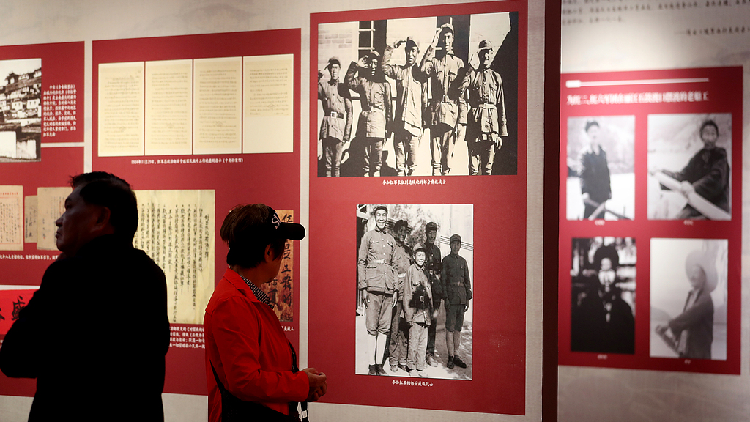
Visitors view an exhibition featuring archival documents and photographs about the Red Army's Long March through Yunnan Province at the Kunming Museum in Kunming, southwest China's Yunnan Province, September 12, 2026. /VCG
For many young Chinese, the Communist Party of China's (CPC) revolutionary history is no longer just something to be read about in textbooks or viewed from behind glass. It is becoming an experience — one that can involve walking through historic sites, taking on a role in a wartime scenario or even stepping into a virtual recreation of the Long March.
That transformation is helping fuel a new wave of "red tourism" in China, as young travelers increasingly visit revolutionary sites, memorials and former revolutionary bases. The trend has gained further momentum this year, which marks the 105th anniversary of the CPC's founding and the 90th anniversary of the victory of the Long March.
The Long March, a historic retreat of the Red Army spanning tens of thousands of kilometers in the 1930s, paved the way for the CPC's eventual defeat of the then-ruling Kuomintang and the establishment of the People's Republic of China in 1949.
During the past summer holiday, many red tourism destinations saw a surge in visitors, with young people making up an increasingly large share.
"Red tourism was particularly popular this summer, with young travelers accounting for nearly 65% of visitors," said Qi Chunguang, vice president of Tuniu, a Chinese online travel agency. Group tours remain popular, he said, with professional guides and carefully planned itineraries helping visitors get more out of their trips.
The trend is also reflected in online searches. According to the 2026 Red Tourism Consumption Trends Report released by Tongcheng Travel, searches for red tourism-related products jumped more than 130% year on year in the first half of 2026. Searches for tickets to revolutionary sites rose 86%, while bookings for red tourism itineraries increased 48%.
Wu Ruoshan, a council member of the Beijing Tourism Society, said the appeal of red tourism among young people stems from both emotional resonance and innovation in tourism products.
"Red tourism is moving from simple sightseeing toward immersive experiences," Wu said, noting that digital technologies and interactive projects are giving young visitors new ways to connect with history.
People use VR headsets to experience immersive scenes from the Long March in Changde City, central China's Hunan Province, September 12, 2026. /VCG
Traditional red tourism often centered on visiting revolutionary sites, viewing historical artifacts and listening to guided explanations. But today's young travelers increasingly want to do more than observe — they want to participate.
The Tongcheng report found that red tourism attractions featuring real-life missions, period costumes and interactions with non-player characters, or NPCs, have seen particularly rapid growth in bookings. Searches combining "red tourism" with "NPC" rose more than 120% during the summer holiday.
In a tourism area in Linyi, east China's Shandong Province, for example, visitors can take part in an immersive film experience called "Follow the Commander to Capture the County." Led by NPCs, participants simulate a battlefield charge as wartime scenes unfold around them.
Scripted mystery games have also found their way into red tourism. Projects such as The Yan'an Spirit recreate historical events through real-life settings, with visitors taking on different historical roles and becoming part of the story rather than simply watching it unfold. Yan'an, located in northwest China's Shaanxi Province, served as the base of the CPC leadership for around 10 years from 1937 to 1947.
Technology is taking that approach a step further.
In Wuhan, central China's Hubei Province, an XR immersive experience titled The Great Expedition has become a major attraction at a local museum. The project recreates scenes from the Long March in an immersive environment, allowing visitors to experience the historical journey in a more immediate way.
In Zunyi, southwest China's Guizhou Province, the Zunyi Conference Memorial Museum is also using technology to make revolutionary history more accessible. 3D mapping and animation bring artifacts and sculptures to life, while VR, AI and holographic imaging allow visitors to revisit historical scenes from a first-person perspective.
Zunyi Conference is widely regarded as a crucial turning point in the Long March. It addressed key military and strategic issues and helped establish new leadership within the CPC Central Committee, with Mao Zedong playing a leading role.
Visitors explore the site of the Lazikou Battle in Diebu County, Gannan Tibetan Autonomous Prefecture, northwest China's Gansu Province, September 9, 2026. /VCG
Technology and creative storytelling may be making red tourism more attractive, but they do not fully explain why young people are coming.
For some observers, the deeper appeal lies in the search for meaning.
As younger generations look beyond material consumption for experiences with emotional and cultural value, stories centered on sacrifice, dedication, responsibility and collective purpose can resonate with their own aspirations.
Some tourism commentators have noted that young people today are growing up in a world marked by uncertainty. Against this backdrop, revolutionary stories can offer a sense of purpose — stories of young people who once confronted extremely difficult circumstances and sought to contribute to something larger than themselves.
The appeal, they argue, is not simply about nostalgia for the past. It is also about asking what kind of person one wants to become in the present.
From another perspective, a People's Daily commentary attributed the popularity of red culture among young people to growing cultural confidence. Today's young generation, it said, is increasingly confident in engaging with the wider world while also eager to understand the historical forces behind China's development.
It wrote that for young people, red tourism can serve as a way to understand both the past and the present: to explore where China came from, how its development path took shape, and what values have continued to influence the country today.