Why tracking Toyota Hilux, not rocket sales, helps predict militia attacks
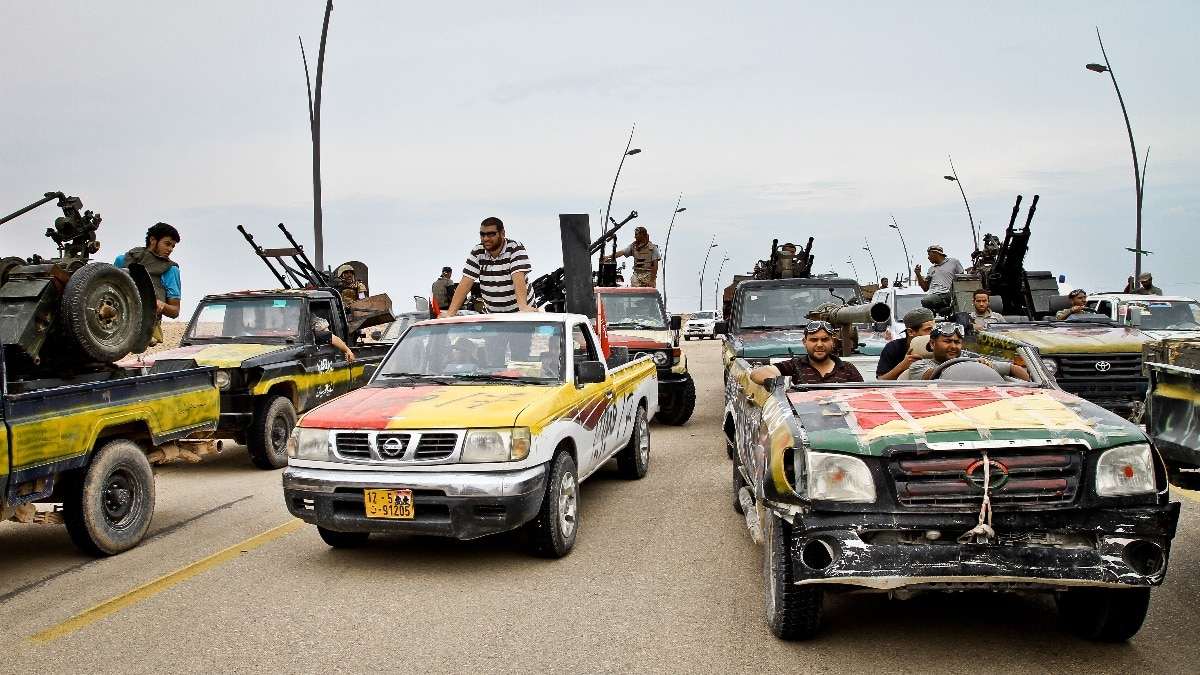
As the Houthis blitzed across Yemen's Red Sea coast last week, videos emerged on social media showing Ansar Allah militias assembling for battle in large lines of pickups, armed with machine guns and rockets, before tearing across the desert in a scene straight out of Mad Max.
If the Kalashnikov-pattern assault rifle is the default weapon of the insurgents and the guerrillas worldwide, there's a good chance their vehicle of choice is the Toyota Hilux pickup. From the Houthis in Yemen, to the IS in Iraq, and even US Special Forces, the Toyota Hilux, along with models from other brands like Ford, Chevrolet and Nissan, has become a familiar sight on battlefields and in conflict zones. The humble pickup truck, decked out with machine guns, autocannons, anti-tank missiles, and other deadly toys is a clear favourite.
The contrast with the armed forces of most modern nations stands out. They spend millions developing sophisticated armoured vehicles that can protect their occupants against all manner of threats. The average insurgent, terrorist, guerrilla, rebel or freedom fighter (depending on how their cause is viewed), meanwhile, is more than happy to ride into battle on a Toyota that would look entirely at home on a city street, but with a machine gun or rocket launcher bolted onto the back.
In the recent Ansar Allah blitz that saw the Houthis take control over most of Yemen's Red Sea coast and gain control of the Bab el-Mandeb Strait, Hiluxes featured prominently among the Iranian-backed group's panoply of vehicles. So why is the Hilux, and other similar pickups in general, so popular among insurgents and other non-state groups? More importantly, how do they get their hands on these pickups?
Vehicles similar in size and stature to the Hilux have always had their place in warfare. For example, in WW2, British special forces in North Africa used jeeps and light trucks to mount raids behind Axis lines.
But why is the Hilux so popular among non-state actors these days? The roots of this preference go back to the late 1980s, during the final stages of the Libyan-Chad War.
The Sub-Saharan nation of Chad, which had been fighting a decade-long war with Muammar Gaddafi's Libya, was supplied with 400 Hilux and Land Cruiser pickups, along with anti-tank and anti-air missiles, by their former coloniser, France.
These Toyotas, operating in conjunction with French air support, allowed Chad to pull off a series of stunning military victories against their Libyan opponents.
This war, later given the moniker, the Toyota War, demonstrated how, in the right hands, the Toyota could be a formidable weapon. Their speed and manoeuvrability allowed them to dodge enemy fire, run circles around lumbering Libyan tanks, and strike where least unexpected.
At the same time, they were cheap, durable, and could be maintained by just about any mechanic with basic tools. Being highly popular civilian vehicles around the world, spares are usually easy to come across. And unlike weapons, a Toyota Hilux or a Ford F-150 does not need to circumvent export restrictions to reach their rebelling customers.
The 1987 war was only the start of the story of how the insurgents learnt to love the Toyota. Over the years, more and more non-state actors, from the mountains of Afghanistan, to the deserts of Iraq to the streets of Somalia, the Toyota Hilux, and other pickups, were everywhere.
They also acquired a unique nickname of their own, that is, "technicals". The term emerged in Somalia in the early 1990s, when aid agencies paid armed local groups hired to protect their personnel and supplies under the euphemism of "technical assistance". The name eventually stuck to the weapon totting pickups they travelled in.HOW DO INSURGENTS AND NON-STATE ACTORS ACQUIRE TOYOTAS, OTHER PICKUPS?
Whether it's the IS militants parading black Hilux's in captured Iraqi cities, or Houthis mad maxing them across Yemen's Red Sea coast, the Toyota is everywhere. The question is, how do these non-state actors acquire them, and in such large numbers.
It is not just us who are asking this question. Back in 2015, when ISIS was at its peak, US counter-terror officials were reported to have demanded an explanation from Toyota as to how the terror group was acquiring so many Hilux's and Land Cruisers.
Toyota has, for its part, denied selling cars and trucks to insurgents, stating back in 2015 that it has a "strict policy to not sell vehicles to potential purchasers who may use or modify them for paramilitary or terrorist activities".
Toyota's own figures show sales of Hilux and Land Cruisers tripling from 6,000 sold in Iraq in 2011 to 18,000 sold in 2013, before sales dropped back to 13,000 in 2014, reported ABC news. This was before IS launched a massive offensive inro the country from Syria, which reached as far as the outskirts of the capital Baghdad.
But even if Toyota does not directly sell vehicles to terrorists, the latter has their own means. The widespread popularity of the Hilux worldwide means that second-hand models are always available on the open market.
"We can only assume that these vehicles come from back channels and are exchanged among individuals. Such unofficial dealings, particularly in used vehicles, are very difficult for an automaker to follow," the company had stated back in 2014.
In one particularly unfortunate case, an American plumber's Ford pickup, which had his name and phone number written on the door, was sold to IS militants in Syria. The Ford, fighting for IS with signage still intact, ended up being broadcast on news channels across the US. Hardly the kind of publicity the company would have wanted.
Non-state actors can also use middlemen, who purchase vehicles from local and even foreign markets. They are then transferred into the hands of their final users in order to circumnavigate company policies. These might show up in the form of booming sales prior to the start of major conflicts, with figures from Toyota noting a massive jump in sales prior to an IS offensive in Iraq in 2013.
As Hiluxes race across Yemen's Red Sea coast, the question is how the Houthis acquired their fleet of Toyotas in the first place. Did they buy them second-hand, acquire them from showrooms through intermediaries, smuggle them in from abroad, or simply steal them? However they are obtained, the bare-bones Hilux remains an insurgent classic.- EndsPublished By: Shounak SanyalPublished On: Sep 15, 2026 12:39 IST