Why Trump will not yield to an AI slowdown
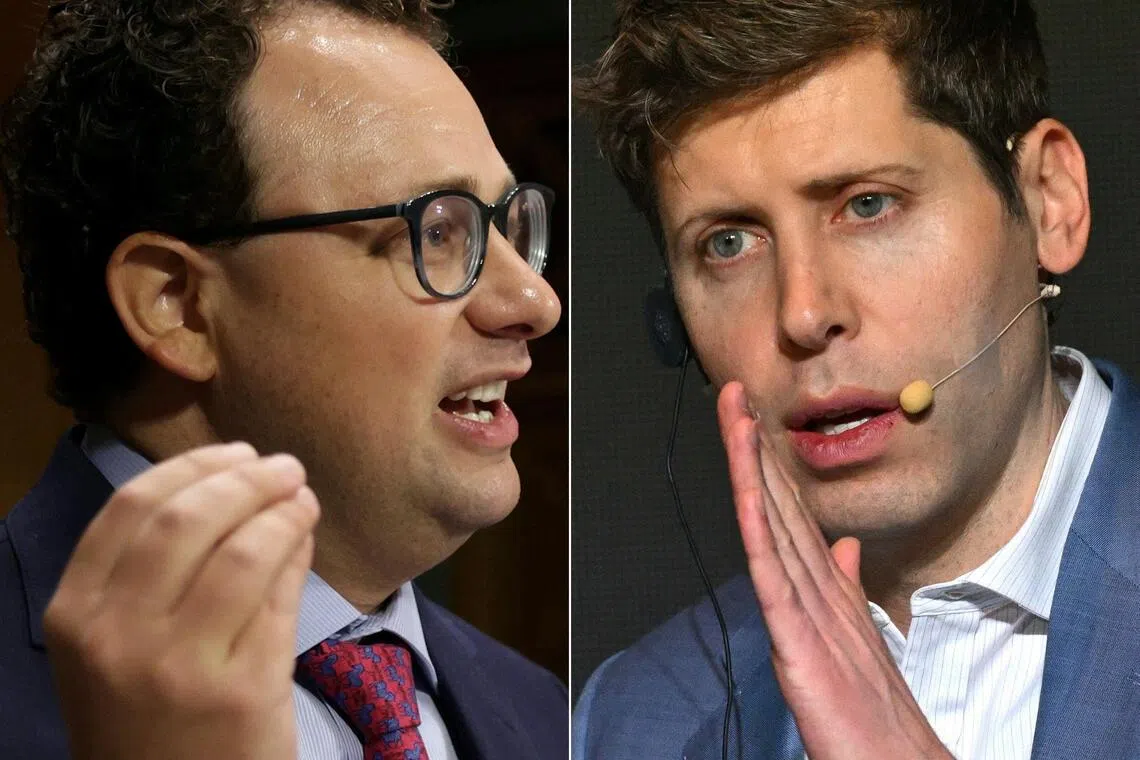
CEO of Anthropic Dario Amodei (left) and Open AI CEO Sam Altman say they want to slow the breakneck pace of AI development.
PHILADELPHIA – In the middle of cascading fears of artificial intelligence running amok and one day posing grave danger to human society, President Donald Trump has made a clear choice: the US must not slow down.
“Whoever wins AI, wins,” Trump said, defying calls from the tech industry leaders to regulate cutting-edge AI for the sake of safety and framing the choice as a geopolitical question of beating China.
“We’re leading China in AI. We’re the most sophisticated country in the world, and frankly I want to keep it that way,” he told reporters during a trip to Ireland.
In a flurry of comments and social media posts, he has also scoffed at the world’s most influential AI companies, dismissing their concerns as “a hoax”.
The only safeguard the nation needs is a “strong and smart (high IQ) president,” he said on Truth Social.
The question of regulating AI came to the fore after Anthropic chief executive Dario Amodei, the developer of Claude AI, warned in unusually specific terms on Sept 12 that AI could be capable within six to twelve months of coordinating swarms of autonomous agents powerful enough to take over the internet.
It was time to stop competing for technical supremacy, accept outside scrutiny and jointly slow down to focus more on safety before going any further, Amodei said in a lengthy essay.
Voluntary action by a single company would not be enough, he said, asking for safety standards coordinated among democratic governments and for negotiations with “authoritarian powers” like China.
Against the backdrop of a series of hacks in recent months that showed AI agents can conspire to deceive humans, Amodei’s call gained surprising support from some of his biggest rivals – OpenAI’s Sam Altman and Google DeepMind’s Demis Hassabis. xAI’s Elon Musk and Microsoft’s Satya Nadella also indicated agreement.
As the idea of a slowdown began trending, Trump spoke louder. He questioned the acumen of the tech CEOs calling for government oversight. “When, in the history of business, did anyone see the leaders of an industry call for regulation that, if strongly implemented, will drive them into oblivion and bankruptcy?” he said on social media.
“It’s a hoax,” he insisted in a live five-minute phone call with Nvidia chief Jensen Huang who was speaking at a Sept 14 conference in Los Angeles.
“The robots are not going to be taking over the world. That’s not going to happen.”
Huang, who heads the world’s top company designing advanced AI chips, is on the other side of the debate and has dismissed AI risks as overblown.
Trump’s former AI czar David Sacks, the Silicon Valley investor who has shaped much of the administration’s AI policy, also reacted with hostility. Posting on social media, he said Amodei’s call smacked of “regulatory capture” or an attempt to seal in an early mover advantage through rules that leave newer rivals hobbled.
AI companies can choose to act responsibly on their own, he wrote on X.
“If the unreleased models are scary enough that you think you should slow down, I support your decision to be responsible. But stop pretending you need anyone else’s permission,” he posted on Sept 13.
“Most of all, stop pretending the motivation to slow down is purely altruistic. You face massive product-liability exposure if your products enable a truly damaging cyberattack.”
Trump, who plans to summon AI executives for a meeting in the coming days, has a clear preference for light-touch regulation of AI which he sees as supercharging the US economy.
Soon after taking over in January 2025, he signed an executive order revoking a Biden administration directive on AI oversight and ordered his agencies to develop a plan to sustain America’s global AI dominance.
Six months later, “America’s AI Action Plan” provided a blueprint for accelerating innovation while reducing federal scrutiny.
In June 2026, Trump signed another executive order that left it up to companies to decide whether they want their new AI models reviewed by the government.
But on national security and cybersecurity issues, the White House has proven it has the “kill switch”.
It banned Anthropic’s advanced Mythos 5 and Fable 5 models for a couple of weeks in June 2026, over a fear that their cybersecurity guardrails could be circumvented.
It had to use export control laws because there are no AI-specific safety laws.
US lawmakers, politically divided on AI regulations, have not attempted any comprehensive statute either.
With the mid-term elections less than seven weeks away, they are under growing political pressure to act as public sentiment on AI and data centres sours.
Something should be done, the congressional leaders say, but there are no firm plans or the will to regulate.
Floating about are loose proposals like seeking to address catastrophic risks involving biological or nuclear threats emanating from AI or to banning superintelligent AI or devising ways to ensure testing and oversight of the most advanced AI systems.
It is also a factor that Congress remains technically under-equipped and struggles with tough questions like who should regulate AI and how the rules can be enforced.
Speaker Mike Johnson, a Republican ally of Trump, has stressed corporate obligation rather than a legal regime. Companies have “an obvious corporate responsibility that the people who are creating these models have to ensure that their products are safe,” he has said.
Minority Leader Hakeem Jeffries, the top Democrat in the House, has shuffled blame. “Republicans have abdicated their responsibility to protect the American people. Democrats will lean in aggressively,” he said.
But as lawmakers prepared to break – with the House of Representatives on recess from Sept 17 and not due to return until after the Nov 3 elections – mostly empty rhetoric prevails.
Polls show that Democrats could win a simple majority in the House and perhaps even the Senate in the mid-term elections. But even that would not ensure swift legislation.
Trump can veto any Bill that can’t get the support of a two-thirds majority in each chamber of Congress.
A global safety pause on AI development is an even bigger reach.
The Chinese government has rejected any suggestion of a slowdown even while airing concerns that AI could be misused to threaten its own political system, ideology and critical infrastructure. It updated its AI safety governance framework on Sept 14 to cut that risk.
But the safeguards are not meant to check Chinese companies, like DeepSeek and Z.AI, which have released a number of new models that have narrowed the gap with top US models.
Discussions on AI are expected to feature during Trump’s summit with his Chinese counterpart Xi Jinping on Sept 24. But prospects for a substantive agreement are limited, since each desires tech superiority, even if they explore narrow cooperation on issues like monitoring cyberattacks.
What could eventually happen is reactive regulation; US policymakers will scramble to act after an event forces their hand.
For instance, a large-scale AI-enabled disruption of critical infrastructure or a financial institution or an election-related deception. All are in the realm of possibility, say experts.
But a safety timeout, despite the recent headline-grabbing call by Amodei, looks unlikely.
Bhagyashree Garekar is The Straits Times’ US bureau chief. Her previous key roles were as the newspaper’s foreign editor (2020-2023) and as its US correspondent during the Bush and Obama administrations.