Worried about AI taking your first job? These 26 degrees rank lowest for exposure
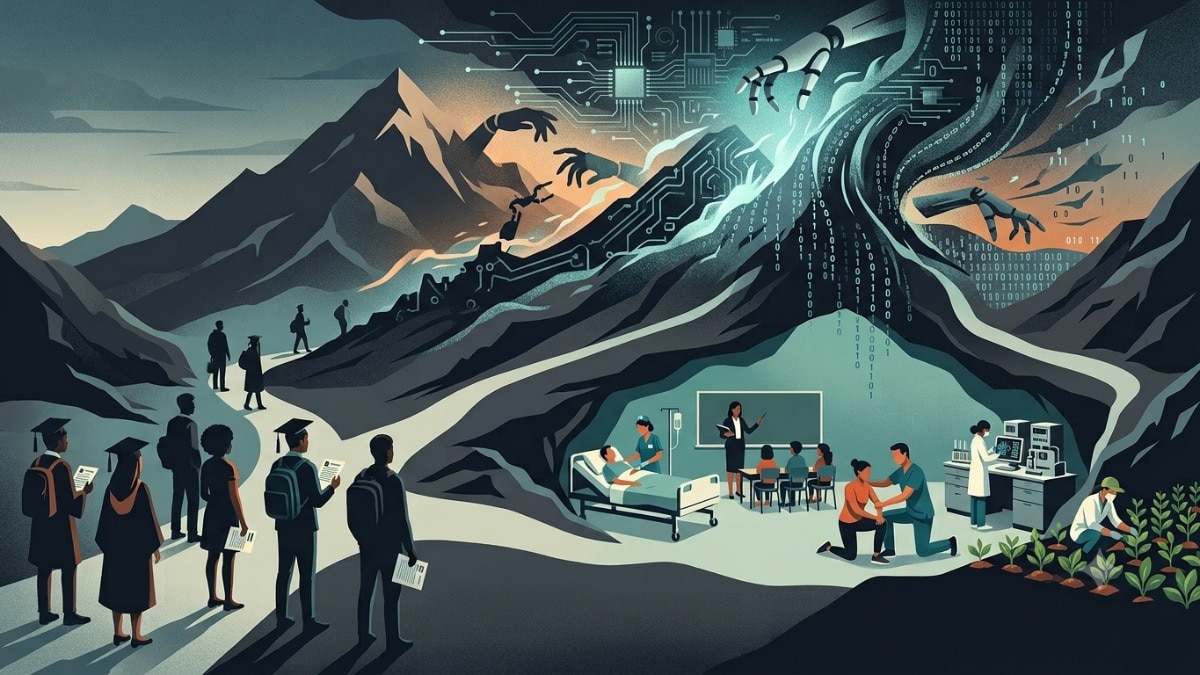
For students choosing a college degree in 2026, the biggest question is no longer just 'Which career will pay well?' It is also 'Will there still be a job waiting for me when I graduate?'
The rapid spread of generative AI has put fresh pressure on entry-level jobs, particularly in fields where software can already handle parts of the work. A new US Census Bureau working paper has now mapped college majors according to how exposed the careers linked to them are to AI.
While majors such as computer science, accounting, journalism and several engineering fields sit towards the higher-exposure end, there is another group at the opposite end.
Here, we focus on Levels 1 and 2, the two lowest AI-exposure categories in the study listing 26 majors in total. They include nursing, teaching, therapy, medical technology, healthcare, forestry, zoology and several other fields.
That does not mean these are "AI-proof" careers, or that they guarantee a better starting salary. It simply means the occupations associated with these majors had the lowest measured exposure to AI in this particular US study.
For those worried about their first job and first pay cheque in an AI-heavy economy, these are the careers worth examining more closely.LEVEL 1: THE LOWEST AI-EXPOSURE MAJORS
The lowest category contains nine majors, with Nursing having the largest number of graduates in the study's 2018-22 data.LevelCollege majorCareer paths commonly associated1NursingRegistered nurse, clinical nurse, hospital nurse1Treatment Therapy ProfessionsPhysical, occupational and other therapists1Elementary EducationPrimary school teacher1Teacher Education: Multiple LevelsSchool teacher, education specialist1Medical Technologies TechniciansMedical laboratory and diagnostic roles1Special Needs EducationSpecial education teacher1Early Childhood EducationPreschool and early-years educator1Educational Administration and SupervisionSchool administration, education management1Medical Assisting ServicesMedical assistant, clinical support roles
These are the majors the paper places in GPT-4 Beta exposure decile 1, its lowest exposure group. LEVEL 2: STILL AMONG THE LOWEST
Level 2 adds another 17 fields, ranging from healthcare and teacher education to zoology, forestry and animal sciences.LevelCollege majorCareer paths commonly associated2General Medical and Health ServicesHealthcare administration and services2EcologyEcologist, environmental roles2Criminal Justice and Fire ProtectionPolice, corrections, fire services2Social Science or History Teacher EducationSchool teaching2Science Teacher EducationScience teacher2Art and Music EducationArt or music teacher2Transportation Sciences and TechnologiesTransport operations and technology2Mathematics Teacher EducationMathematics teacher2Language and Drama EducationLanguage or drama teacher2Physical Fitness, Parks, Recreation and LeisureFitness, recreation and parks roles2Secondary Teacher EducationSecondary school teacher2General EducationTeaching and education services2ForestryForestry and conservation roles2ZoologyZoology and wildlife-related roles2Plant Science and AgronomyAgriculture, crop and plant science2Animal SciencesAnimal science, livestock and related roles2Physical and Health Education TeachingPE and health teacher
The paper's Appendix Table A3 places these fields in GPT-4 Beta exposure decile 2.NURSING: A CAREER WHERE AI CANNOT DO THE WHOLE JOB
Nursing sits in the lowest AI-exposure category, with about 222,000 graduates represented in the paper's 2018-22 data. The work involves direct patient care, physical procedures, monitoring, communication and decisions made in changing clinical situations.
That does not make nursing immune to AI, but the occupation's exposure score is among the lowest in this study. Globally, WHO says nurses remain the largest occupational group in healthcare and an essential part of health systems. TEACHING ALSO APPEARS REPEATEDLY
Education-related majors dominate much of Levels 1 and 2. Elementary education, special needs education, early childhood education and multiple teacher-training fields all feature in the lowest two deciles.
AI can generate lesson plans, worksheets and other educational material, but the Census classification is based on occupational task exposure, not on whether AI can assist with parts of a teacher's work.HEALTHCARE HAS A STRONG PRESENCE
Nursing is joined by therapy professions, medical technology, medical assisting and general health services in the two lowest exposure levels.
WHO's India health workforce data says the country now has 5,299 nursing institutions producing around 380,000 professionals annually, while also noting the need for more specialised training and a skilled healthcare workforce.advertisement'LOW AI EXPOSURE' DOES NOT MEAN 'HIGH SALARY'This is the important catch for students looking at their first earning potential.
The Census study found a 13% fall in initial earnings for graduates in the most AI-exposed decile, but it does not say that every Level 1 or Level 2 graduate earns more. The study is measuring how employment and earnings changed with AI exposure, not creating a salary ranking of degrees.
So, if the question is "Which degrees currently have the lowest measured AI exposure?", Levels 1 and 2 provide a useful list.
If the question is "Which degree will definitely get me the best first salary?", this study alone cannot answer it.
And there is one more caveat: these are US graduates and US labour-market data, not an Indian ranking. The Census paper itself says its AI exposure measure is a snapshot of a rapidly changing technology.- EndsRead | Degrees in danger? These college majors face the biggest AI job shockRead | Which degrees will AI never be able to replace?