Xiangshan Forum enriches the landscape of global security governance
By continuing to browse our site you agree to our use of cookies, revised Privacy Policy and Terms of Use. You can change your cookie settings through your browser.
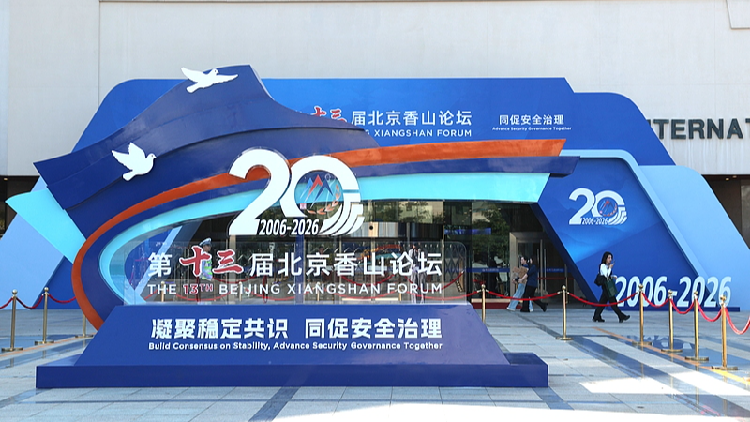
The 13th Beijing Xiangshan Forum is held at Beijing International Convention Center in Beijing, China, September 15, 2026. /VCG
Editor's note: Yuan Sha, a special commentator for CGTN, is the deputy director of the Department for Global Governance and International Organizations Studies at the China Institute of International Studies. The article reflects the author's opinions and not necessarily the views of CGTN.
With geopolitical conflicts raging in many parts of the world and security challenges becoming increasingly interconnected, global security governance faces not only a deficit of solutions, but also a deficit of representation. Whose security concerns can be heard, who could set the agenda, and whose interests could be reflected in the rules and institutions are crucial questions in today’s global security governance.
Against this backdrop, the 13th Beijing Xiangshan Forum, under the theme "Build Consensus on Stability, Advance Security Governance Together," provides an important and inclusive platform for global security governance.
Global security governance has long suffered from a significant deficit of representation, particularly in agenda-setting, rulemaking, and institution-building. This imbalance not only restricts the voice of the Global South, but also weakens the legitimacy and effectiveness of collective responses to both persistent and emerging security challenges.
Africa is a primary victim of this deficit. Its 54 countries account for about 28% of United Nations membership, yet the continent has no permanent seat on the UN Security Council (UNSC) and only holds three nonpermanent seats. Such under-representation in voice but over-representation in challenges led UN Secretary-General Antonio Guterres to caution against a "glaring omission" and "indefensible."
Similar questions arise in major international security forums dominated by the West. For example, the Munich Security Conference has historically been rooted in transatlantic security debates, while recently extending a welcoming gesture to the Global South; its agenda and ideology remain Western-centrist. The Shangri-La Dialogue, despite its wide Asian participation, often frames regional security through military deterrence, alliance politics and great-power competition.
These issues do not capture the full range of security concerns facing the international community, including political strife, terrorism and transnational crime. The Global South also cares more about the development impacts of geopolitical conflicts, such as food and energy insecurity, as well as health and climate-related threats.
Broader representation therefore matters for practical as well as normative reasons. The Ukraine crisis has affected global food and energy supply chains, while tensions around the Red Sea and the Strait of Hormuz have highlighted the vulnerability of major trade and energy routes. At the same time, cyber-attacks, drones, artificial intelligence-enabled weapons and space technologies are creating new escalation risks. Addressing these challenges requires broader participation and more diverse experiences, including those of the Global South.
Against this backdrop, the Beijing Xiangshan Forum's ideas of "Equality, Openness, Inclusiveness and Mutual Learning" are particularly relevant. Established in 2006 as a Track 2 dialogue among defense think tanks, the forum has now evolved into an important Track 1.5 platform hosted by China, bringing together defense and military leaders, representatives of international organizations, former officials and scholars from over 100 countries.
Military representatives attend the 13th Beijing Xiangshan Forum held at Beijing International Convention Center in Beijing, China, September 15, 2026. /CFP
The 2026 forum, marking its 20th anniversary, reflects a broader conception of security. Its four plenary sessions cover international order and strategic stability, localized conflicts, Asia-Pacific security risks, and the role and vision of developing countries. Parallel discussions will address sea-lane security, emerging military technologies and outer-space governance. These issues illustrate how contemporary security increasingly cuts across regions and domains, making wider participation a necessity.
Most notable is the decision to devote a session to "The Role and Vision of Developing Countries." The Fourth China-Africa Peace and Security Forum will also be held alongside the event. As a key member of the developing world, China regards fellow developing countries as active players in mediation and peace operations rather than passive recipients of security assistance, and creates space for them to contribute their own assessments and policy approaches.
Bringing the Global South's perspectives more directly into international security debates could help broaden the agenda beyond major-power rivalry and make global security governance more responsive to the countries most affected by instability.
It’s also worth noting that the Xiangshan Forum provides a practical platform for advancing the Global Security Initiative and its vision of common, comprehensive, cooperative, and sustainable security. Its underlying premise is that security is indivisible, and durable security cannot be achieved by strengthening one state or grouping at the expense of others.
This is particularly relevant amid intensifying geopolitical rivalry and growing fragmentation in the international security architecture. By supporting both South-South exchanges and dialogue between developed and developing countries, the Xiangshan Forum is well positioned to complement existing institutions by bringing together different perspectives, practices, and solutions, encouraging greater understanding across strategic divides, and contributing to a more inclusive and effective system of global security governance.
(If you want to contribute and have specific expertise, please contact us at opinions@cgtn.com. Follow @thouse_opinions on X to discover the latest commentaries in the CGTN Opinion Section.)