Xi's Washington messages and the next phase of China-US relations
By continuing to browse our site you agree to our use of cookies, revised Privacy Policy and Terms of Use. You can change your cookie settings through your browser.
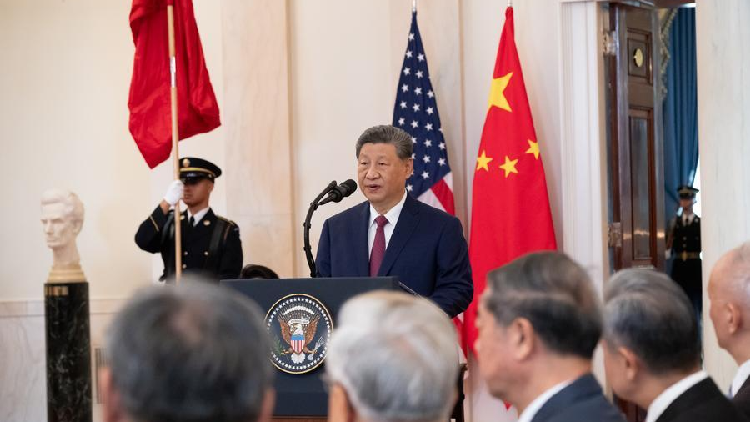
Chinese President Xi Jinping addresses a welcome ceremony by US President Donald Trump at the White House in Washington, DC, the United States, September 24, 2026. /Xinhua
Editor's note: Jessica Durdu, a special commentator for CGTN, is a foreign affairs specialist with a PhD in law. The article reflects the author's opinions and not necessarily the views of CGTN.
The most consequential message to emerge from Chinese President Xi Jinping's Washington meeting with US President Donald Trump may not be any single agreement but the attempt to define a framework within which the world's two largest economies can compete without allowing competition to consume the entire relationship.
That distinction matters. China-US relations have entered a period in which neither a return to the engagement model of previous decades nor complete strategic separation is realistic. The challenge is therefore increasingly one of coexistence: How two major powers with different political systems, strategic priorities and economic interests can manage disagreements while preserving areas of mutual benefit.
Xi's remarks in Washington offer important clues about Beijing's answer. The central phrase of the meeting was "constructive strategic stability." First agreed upon during Trump's visit to China in May, the concept has been given greater substance in Washington. Xi called for transforming this vision into action and developing a more stable, healthy and sustainable bilateral relationship.
The important word here is not simply "stability," but "constructive." Stability in international relations can sometimes mean little more than preventing crises. Xi's formulation appears broader: Manage competition, contain disagreements and simultaneously create additional areas of cooperation.
Indeed, before the summit, Xi described the desired relationship as one featuring "cooperation as the mainstay, moderate competition, manageable differences, and promises of peace."
This is arguably the clearest signal about Beijing's preferred trajectory for China-US relations. It neither denies competition nor assumes that every disagreement can be resolved. Instead, it attempts to place competition inside a larger political framework.
History provides useful context. The normalization of China-US relations itself occurred not because Washington and Beijing suddenly agreed on fundamental issues, but because the leaders recognized that cooperation was possible despite substantial differences. Xi referenced this history during his US visit, recalling how "ping-pong diplomacy" helped reopen bilateral exchanges more than five decades ago.
According to the official account of the summit, the two sides added new substance to the vision for the China-US relationship and agreed to jointly build a constructive relationship of strategic stability based on respect, fairness and reciprocity.
The White House in Washington DC, the US, September 20, 2026. /CFP
Economic relations will provide the first major test of whether this strategic language can translate into practice. The latest round of economic and trade consultations produced a new joint arrangement.
Trump also called for continued dialogue toward a better agreement. This matters beyond tariff schedules or individual transactions. For companies operating across global supply chains, predictability between Washington and Beijing is itself an economic asset.
Xi captured the underlying logic succinctly and said a stable China-U.S. economic and trade relationship requires both expanding the list of cooperation and shortening the list of problems.
The formulation is politically significant because it does not make cooperation conditional on eliminating every dispute first. Instead, it suggests compartmentalization: Negotiate disagreements while simultaneously enlarging areas where interests converge.
That represents a pragmatic model for the wider relationship. Trade tensions, market-access questions and technological competition will not disappear overnight. But they do not necessarily have to prevent cooperation elsewhere.
Artificial intelligence provides perhaps the most forward-looking example. China and the United States are central players in the global AI ecosystem, making the technology an obvious arena of competition. Yet AI safety, misuse, human control and governance are also challenges that cannot easily be contained within national borders.
Xi therefore argued that although the two countries compete in AI, they have even more reasons to cooperate. He proposed continued dialogue on risks and benefits, preventing misuse and abuse, and maintaining human control over AI systems. Trump likewise supported continued dialogue and stronger cooperation in this field.
This could prove an important precedent. During the Cold War, strategic competitors eventually developed mechanisms for discussing nuclear risks precisely because competition made communication necessary. AI is fundamentally different from nuclear technology, but the diplomatic principle has relevance: The greater the consequences of uncontrolled technological competition, the stronger the case for maintaining channels of communication.
The summit also demonstrated that China-US relations increasingly operate on two levels: bilateral and global. The leaders discussed the Middle East, Ukraine and the Korean Peninsula, while agreeing to support each other in hosting the 2026 APEC Economic Leaders' Meeting and G20 Leaders' Summit.
That is significant. Washington and Beijing may approach many international questions differently, but their diplomatic and economic weight means that sustained communication between them can affect issues far beyond the bilateral relationship.
The broader signal from Xi's Washington visit therefore is neither that strategic competition has ended, nor that China-US relations are returning to an earlier era. It is something more pragmatic: Competition and cooperation can coexist.
The real measure of the summit will be implementation. Economic understandings must translate into greater predictability; AI dialogue must develop into sustained communication; sensitive issues must remain manageable; and high-level political consensus must filter down into working-level institutions.
If that happens, "constructive strategic stability" would become more than diplomatic terminology. It would provide a working architecture for a relationship in which differences remain substantial, competition continues, but neither side allows individual disputes to determine the whole.
For a world increasingly affected by what happens between Beijing and Washington, that may be the most consequential signal from Xi's visit: The future of China-US relations does not necessarily depend on eliminating competition. It depends on learning how to govern it.
(If you want to contribute and have specific expertise, please contact us at opinions@cgtn.com. Follow @thouse_opinions on X to discover the latest commentaries in the CGTN Opinion Section.)