Your home test for fake khoya catches starch, not what actually harms you
A small bottle of iodine sits in the kitchen cabinet of more Indian homes than any food safety regulator could ever hope to visit. It comes out once a year, around Diwali, brought down alongside the good china and the strings of lights.
A piece of khoya goes into a pan of water, boils, cools, and receives a few careful drops from that bottle. What happens next, a colour that stays gold or turns to ink, decides whether the sweets get made or the whole batch gets quietly thrown away.
This ritual belongs to millions of households now, inherited the way a recipe is inherited, from a mother or an aunt who learnt it from someone before her.
It is not folklore. It is genuine chemistry, and it works precisely as advertised. I think that is exactly what makes it dangerous to trust completely.
Because the raids give us no reason not to. This September alone, Maharashtra’s Food and Drug Administration seized 32,023 kilograms of suspected adulterated, substandard or misbranded food across the state in a single four-day drive, worth Rs 1,36,20,735 (Rs 1.36 crore).
The stock was overwhelmingly khoya, mawa, peda, ghee and edible oil, precisely the ingredients that fill a festival sweet box. Twelve food licences were suspended on the spot. Maharashtra's FDA seized 32,023 kg of adulterated food worth over Rs 1.36 crore in a single four-day drive this September. (Photo: Unsplash) A family reading that figure does not have a laboratory on standby, and I do not think it should be expected to. So it reaches for what it has: an iodine bottle bought for a few rupees, a pair of palms, a match. I understand the instinct completely.
What worries me is how far that instinct is being asked to carry us.DOES THE IODINE TEST ACTUALLY WORK?
Genuinely, yes, and I want to say that plainly before I say anything critical. Iodine reacts with starch to produce that unmistakable blue-black colour, a piece of chemistry so reliable it is taught in every school laboratory in the country.
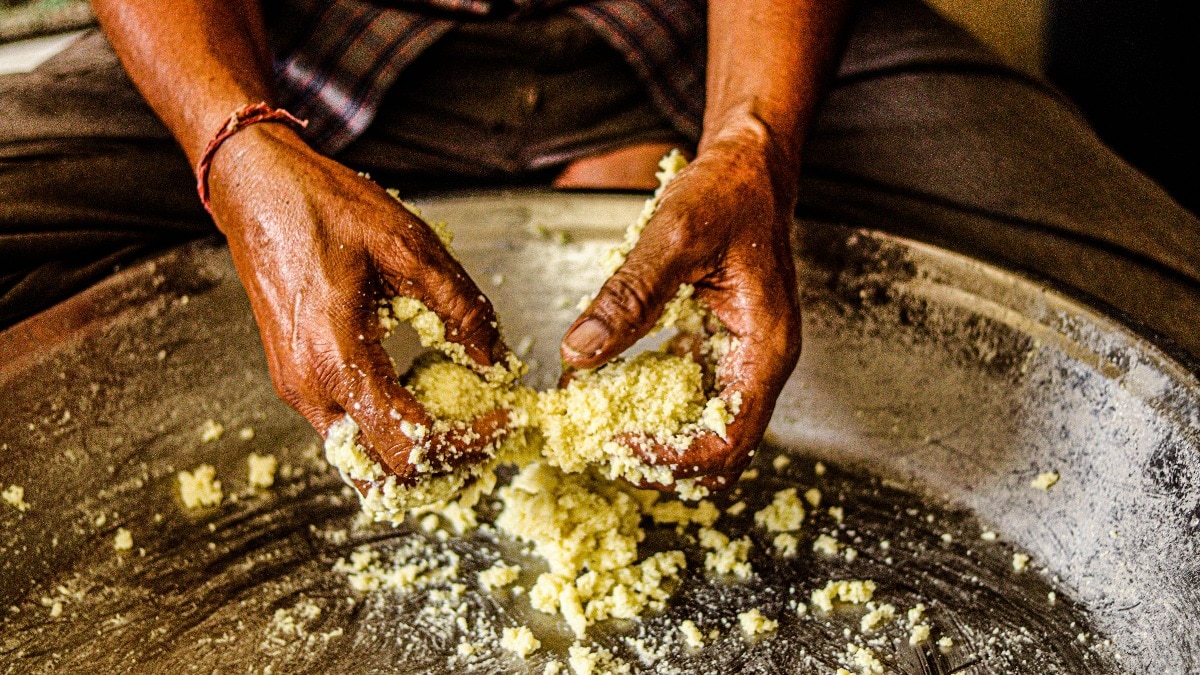
Adulterators often bulk out khoya with maida or suji, refined wheat flour or semolina, simply to add cheap weight. Boil a sample, cool it, add the drops, and if starch is hiding inside, there is no ambiguity left to argue with.
The palm rub carries its own small, satisfying theatre. Rub pure khoya between warm hands for a minute, and it should feel smooth, releasing a faint, milky warmth. Iodine turns deep blue-black in the presence of starch, a reliable and simple piece of school-level chemistry. (Photo: Pexels)
A sample cut with detergent or synthetic filler tends to feel grainy or leave behind something you cannot quite name, a residue that sits wrong against the skin.
Burnt over a flame, genuine khoya gives off the scent of scorched milk. The adulterated version, more often than not, smells faintly of plastic, a difference most people notice within seconds, sometimes before they have consciously registered why.
None of this is superstition dressed up as science. These are simplified versions of tests food scientists themselves use, and I think they deserve real credit for reliably catching the crudest, cheapest forms of adulteration: starch, added water, detergent-based bulking.SO WHAT ARE THESE TESTS ACTUALLY MISSING?
The adulterants that do not announce themselves through texture or smell, and I think this is the part of the story we tell ourselves least often.
Formalin, a preservative solution containing formaldehyde, is sometimes added to extend a product's shelf life during transport, precisely the kind of long-distance movement Maharashtra's own raids have exposed this season. In Chhatrapati Sambhajinagar this September, officers acting on intelligence about incoming transport trucks intercepted a consignment of adulterated khoya-based sweets travelling in from Gujarat, manufactured using palm oil and vanaspati rather than dairy. A consignment of adulterated khoya intercepted in Chhatrapati Sambhajinagar this September had travelled in by truck from Gujarat. (Photo: Unsplash)
Formalin poses a different order of danger altogether. It is a known toxin linked to organ damage with repeated exposure, and unlike starch, it leaves nothing behind for a palm or a flame to notice.
A kitchen test for formalin does technically exist, mixing a sample with concentrated sulphuric acid and watching for a violet or blue ring. In practice, almost nobody performs it, and I do not think anybody should be expected to. The chemical is corrosive, genuinely hazardous without proper equipment, and entirely unsuited to a home kitchen. The same is true of hydrogen peroxide and textile-grade dyes, sometimes used to whiten or brighten a product, neither of which a palm rub or a burn test was ever built to catch.advertisementSO WHY DOES THE MYTH THAT WE ARE PROTECTED PERSIST?Because the tests that do work are visible and satisfying, and the ones that matter more are neither of those things, and I think that asymmetry is doing more damage than any single adulterant could.
There is a real, if entirely unintentional, piece of safety theatre at play in that kitchen ritual. A household performs a genuine test, gets a genuine result, and reasonably concludes the khoya is safe. The test was not wrong. It was simply never built to answer the question that matters most: is this product carrying an industrial preservative or a bleach, rather than simply being padded with flour?
I do not think that distinction is academic. Starch adulteration cheats a buyer's wallet.
Formalin and hydrogen peroxide, at the concentrations sometimes found in adulterated food, threaten a buyer's health, and it is precisely this second, more dangerous category that a kitchen test is least equipped to see.WHAT SHOULD AN ORDINARY FESTIVAL SHOPPER ACTUALLY DO?
Keep the iodine bottle. Keep the palm rub, the burn test, the whole quiet ritual, since it still catches a meaningful share of adulteration and costs nothing but a few minutes of attention. What I would ask is that a clean result be treated as partial reassurance rather than a certificate of safety, because that is all it was ever able to offer.
The far more reliable signal, I think, requires no chemistry at all: where the khoya actually came from, and how it got to the shelf in front of you. A known, established shop that mills or sources locally carries less risk than an unbranded seller offering festival sweets at a price that seems too good to explain. Maharashtra's raids this month make that point starkly. Where khoya comes from, and how far it travelled, may be a more reliable signal than any home test. (Photo: Pexels)
The product intercepted near Shahnoor Dargah had travelled from Gujarat by truck before it ever reached a shelf, moved specifically because it could be produced and sold more cheaply than anything made honestly, close to home, from real milk.
A drop of iodine will tell a household tonight whether its khoya has been padded with flour. It will tell them nothing about the truck it arrived in, or the preservative that kept it looking fresh along the way. This festival season, I think that gap, between what a home test can see and what can actually endanger a family, is worth carrying into the shop with you, before the sweet box is ever opened.- Ends
Radifah Kabir tries to make the universe slightly less mysterious as Senior Sub-Editor at India Today’s Science Desk. A lifelong lover of physics and mathematics, she has spent four years (and counting) translating complex physics papers into English, chasing scientists for interviews, and writing explainers that don’t put readers to sleep. Off-duty, her heart belongs to Lana Del Rey's melodies, Quentin Tarantino's films, poetry, the Star Wars universe, good English movies, series and books, and one very demanding cat.